MARCH 8

                    BIG JOHN PATTON
                    Oh Baby


                    Recording Date:
                         March 8, 1965


                    Personnel:
                         Ben Dixon          D
                         Grant Green       G
                         Blue Mitchell      TP
                         Big John Patton  O
                         Harold Vick        TS


Review by Michael Erlewine
Patton's fourth album for Blue Note. Big John Patton with Grant Green on guitar and Harold Vick on tenor sax. With tunes like "Fat Judy" and "Good Juice," there is no worry about there being a groove. The addition of a trumpet (Blue Mitchell) means you have a horn section, and this tends to be a little much now and again. Although a little on the light side, thanks to Patton and Green, the groove does go down.


MARCH 7

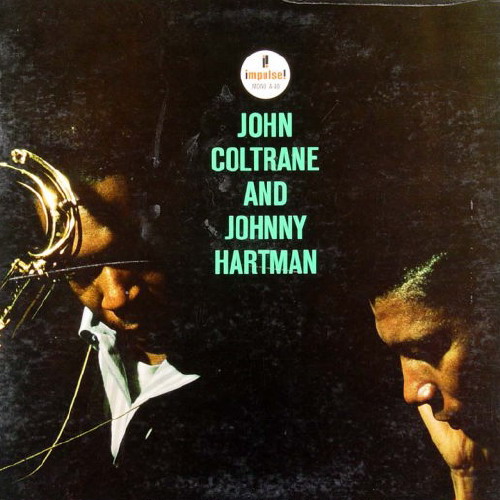
                     JOHN COLTRANE
           with Johnny Hartman

                    Recording Date:
                        March 7, 1963


                    Personnel:
                       John Coltrane     SS,TS
                       Jimmy Garrison   B 
                       Johnny Hartman  Vo
                       Elvin Jones         D
                       McCoy Tyner       P 


Review by Scott Yanow
John Coltrane's matchup with singer Johnny Hartman, although quite unexpected, works extremely well. Hartman, who had not recorded since 1956, was in prime form on the six ballads, and his versions of "Lush Life" and "My One and Only Love" have never been topped. Coltrane's playing throughout the session is beautiful, sympathetic, and still exploratory; he sticks exclusively to tenor on the date. At only half an hour, one wishes there were twice as much music, but what is here is classic, essential for all jazz collections.
 

MARCH 5

                 JACK KEROUAC
      Poetry for the Beat Generation
                   
                     Recording Date:
                            March 1957


                     Personnel:
                           Jack Kerouac  Vo
                           Steve Allen     P


Review by Bruce Eder
Poetry for the Beat Generation marked Jack Kerouac's debut as a recording artist. Strangely enough, it was the by-product of a disastrous first show by Kerouac in an engagement at the Village Vanguard during December of 1957. For the second performance, Kerouac's friend Steve Allen provided the accompaniment at the piano, with results so impressive that it would lead Kerouac to a short but dazzling career as a recording artist. The first result was this album, which came at the suggestion of either Allen or his friend, producer Bob Thiele, who was working for Dot Records at the time. The record was cut in a single session and a single take for each piece. Allen's graceful piano opens the recording and Kerouac comes in, reading "October in the Railroad Earth" for seven minutes, off of a roll of paper in front of him. Kerouac's reading are in a class by themselves, and separate from Allen — the two performances co-exist and weave together without ever really joining, and the result is a peculiar form of jazz; Kerouac did his thing, Allen did his, and the result was a spellbinding performance, and it was musical, despite Kerouac's seeming monotone reading, which never slowed or otherwise interacted with Allen's piano — his voice dances to its own beat, with Allen embellishing and working around him; in the process, you get visions of various facets of Kerouac's work and personality, in extended pieces such as "October in the Railroad Earth" and short, piercing brilliant exclamations such as "Deadbelly" and "Charlie Parker." The resulting album, cut in March of 1958, was one of the crowning achievements in recording of the 1950s. But it so appalled Randy Wood, the president of Dot Records, with its meandering narrative and daring language and subject matter, that the release was canceled, with Wood denouncing the recording in the trade papers as tasteless and questionable. Somewhere over 100 promotional copies of the Dot album (catalog number 3154) had gotten out to disc jockeys and reviewers, however, thus making it one of the rarest LPs in the label's entire history. Thiele finally left the company over the dispute and he reclaimed the master tape — it was on the Hanover label, formed with Allen (who was virtually a pop-culture institution at the time), that Poetry for the Beat Generation finally reached the public in June of 1959. It's still worth a listen now every bit as much as it was in 1959, and perhaps even more so. [Reissued on Rhino's Jack Kerouac Collection, with one bonus track.]
The ultimate Beat Generation collectible on vinyl might be Jack Kerouac’s Poetry of the Beat Generation on Dot Records. Attempting to capitalize on the bestselling On the Road of the fall of 1957 as well as the West Coast craze for jazz poetry readings, Kerouac began a short, troubled career as a spoken word artist. In December 1957, Kerouac signed up for a multiple date engagement at the Village Vanguard. Kerouac lasted about a week. His first show was an out and out failure. Audiences failed to respond to Kerouac; Kerouac was nervous and unsure in his performance; and the musicians just did not mesh with Kerouac. In the second performance, Kerouac read with TV personality Steve Allen playing piano in the background. Kerouac found his voice and his sideman. The decision was made to cut an album. Kerouac and Allen worked with Allen’s friend Bob Thiele who was a producer at Dot Records.

Written by Jed Birmingham and published by RealityStudio on 22 March 2006.
Kerouac showed up at the recording studio with a bottle of rotgut wine and read with Steve Allen for about an hour. The recording engineer congratulated Kerouac on an excellent first take. Kerouac responded that it was the only take. According to the philosophy of spontaneous prose and first thought best thought, Kerouac sought to capture the spirit of his initial creation. Kerouac read both short and extended pieces. “October in the Railroad Earth” is especially wonderful. The entire LP is fresh and alive showing Kerouac to be an accomplished performer of his work. As an example of jazz poetry readings, Poetry of the Beat Generation might be the finest example and it remains to this day one of the best spoken word albums of all time.
It almost did not see the light of day. Randy Wood, Dot President, heard the record just before its release to the public. He was outraged by the frank language and subject matter. Today the record seems tame. Wood declared the record obscene and stated that he would not let his son listen to it. Wood believed that every record on his label had to be family entertainment and suitable for children. He ordered the record to be destroyed. Fortunately for collectors 130 copies (Dot 3154) were sent to reviewers before Wood’s announcement. Copies have survived over the years but the LP is incredibly rare. I saw a copy on eBay years ago that sold for a couple thousand dollars. I have not seen a copy since. Thiele and Allen left Dot Records with the master tape and formed Hanover Records. The Kerouac album was released intact on Hanover in June 1959. Kerouac released another LP on Hanover called Blues and Haikus with Zoot Sims. Soon after Kerouac released another LP on Verve titled Reading by Jack Kerouac on the Beat Generation. All these albums are highly sought after fetching $100-$200. These records are now available on CD on the Kerouac Collection set.


MARCH 4


                    SAM RIVERS
                    Exultation


                     Recording Date:
                         March 4, 1974

                     Personnel:
                         Sam Rivers          SS,TS

                         Gregory Maker      B
                         Warren Smith       D
                         Harold Smith        Per
                         Fred Kelly   SS,AS,BS,FL,Pic

                                         Joe Ferguson                 SS,AS,FL
                                         Roland Alexander            SS,TS,FL
                                         Paul Jeffrey                     TS,FL, Bstt
                                         Sinclair Acey                  TP,FG
                                         Ted Daniel                      TP,FG
                                         Richard Williams              TP,FG
                                         Majeed Greenlee              TB
                                         Charles Stephens              TB
                                         Joe Daley                        Eup,TU


Review by Troy Collins
Long before Sam Rivers' late 1990s big band albums, Inspiration and Culmination were nominated for Grammys, there was Crystals, from 1974. Although Crystals is Rivers' earliest foray into large-scale ensemble writing, it is by no means an embryonic effort. Recorded in the halcyon days of the loft-jazz scene, Crystals is a somewhat more accessible affair than one would expect. In the experimental big band tradition of Muhal Richard Abrams, Anthony Braxton and Sun Ra, Sam Rivers' first big band album makes a fine contribution to this often under-sung genre.
The opening cut, "Exultation" lives up to its title. Horn lines weave around each other as River's soprano snakes through them, never flagging in intensity. "Tranquility" follows, with a funky acoustic bass and tuba ostinato leading the ensemble into a mid-tempo groove. "Postlude" is a short interlude that leads into the albums second side, starting with "Bursts," a scorching free-bop feature for River's furious tenor. The march-like collective improvisation "Orb" takes the energy level down just a notch to prepare for the climactic closer, "Earth Song".
Embracing the discordant linear quality of Muhal Abrams writing, albeit less rigid, more swinging and occasionally even funky, Rivers big band compositions are more accessible than Braxton's but further out than anything Mingus had attempted at the time. While Crystals may be the blueprint for his more recent big band albums, it is more than just a historical curiosity. Not for the faint of heart, Crystals is creative orchestral music at it's most challenging and rewarding.

MARCH 3

   
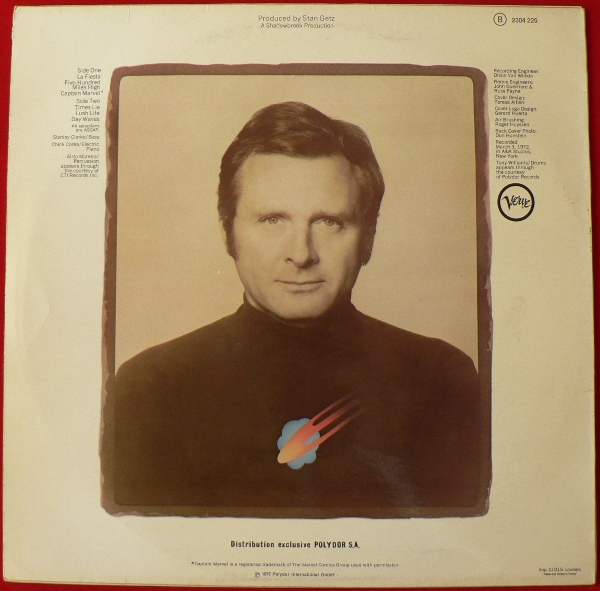
              STAN  GETZ
            Capitan Marvel

                Recording Date:
                    March 3, 1972


              Personnel:
                   Stan Getz        TS
                   Chick Corea     Key
                   Stanley Clarke  B
                   Tony Williams  D
                   Airto Moreira   Per


Review by Thom Jurek
One of the more remarkable aspects of Stan Getz's 1972 masterpiece is just how organic he was able to keep the sound. The band surrounding Getz on this Columbia date was led by Chick Corea with his Return to Forever (electric) bassist Stanley Clarke, drummer Tony Williams, and Brazilian master percussionist Airto. With the exception of Clarke, all the rest had played with Miles Davis in his then-experimental electric bands. Corea's Return to Forever was just getting itself off the fusion ground, while Williams had been with John McLaughlin and Larry Young in Lifetime on top of his experience with Davis. But make no mistake, this is a Stan Getz record, his gorgeous tenor tone furiously and fluidly playing through all of Corea's difficult changes on Corea's Latin carnival jam "La Fiesta" and shapeshifting his way through mode changes on "Five Hundred Miles High" and the bonus version included on the CD, along with another version of the title track and an ensemble recording of "Crystal Silence" (which Corea would later record with Gary Burton). The nucleus for the bedrock of Return to Forever was in the Getz laboratory of extended complex harmony and a strict adherence to melodic improvisation. The two versions of "Five Hundred Miles High" here are striking in that the one included on the album moves along with near samba pacing with wailing solos by Getz. But the unreleased one moves along at the shimmering, crystalline, and slower loping speed that the Return to Forever band did with Flora Purim on vocals. Billy Strayhorn's "Lush Life" is the space in which Getz teaches the band about dynamic, texture, and ambience -- he even has Clarke bowing his bass. This band, combining as it did the restlessness of electric jazz with Getz's trademark stubbornness in adhering to those principles that made modern jazz so great, made for a tension that came pouring out of the speakers with great mutual respect shining forth from every cut -- especially the steamy Latin-drenched title track. Along with Sweet Rain recorded for Verve, Captain Marvel is the finest recording Getz made in the 1970s.

MARCH 2

             DAVE BRUBECK
             Jazz At Oberlin

                 Recording Date:
                       March 2, 1953


                 Personnel:
                       Dave Brubeck   P 
                       Ron Crotty       B 
                       Lloyd Davis      D
                       Paul Desmond  AS 


Review by ~A Customer (Amazon)
This recording is 50 years old but loses none of its luster. The sheer joy of the performance and the appreciation of the audience makes this album pure pleasure. The last four tracks are among the best that Brubeck and Desmond ever did. The creativity and chemistry among the musicians has few rivals in the jazz genre. Amusing quotes and references to other songs, quasi-classical forms including Bach-like fugues between Brubeck and Desmond make for much fun in listening (I always hear something new) and it swings!


MARCH 1

               PAUL CHAMBERS
               Chamber's Music
        

                Jazz Delegation from the East

                    Recording Date:
                         March 2, 1956


                    Personnel:
                         Paul Chambers    B
                         John Coltrane     TS
                         Pepper Adams     BS
                         Curtis Fuller        TB
                         Kenny Drew        P
                         Philly Joe Jones  D


Review by Freshsounds.com
When these two sessions took place, Paul Chambers was still a young musician whose work with the Miles Davis Quintet had stirred much excitement. Both sessions are very special because they were not even scheduled dates. 
The first, recorded in two hours for Jazz:West, a small Los Angeles label, was actually a date with the Davis group minus the leader and with Kenny Drew in for Red Garland. The second, recorded a few weeks later for Transition, another small label based in Cambridge, Mass., came out of a rehearsal session for a planned and unfinished album.
On both sessions Chambers shows to the full his remarkably expressive sound and technique. He could also be quite moving when he played the simplest and most direct lines, and his solos virtually claimed a spotlight for the instrument in its own right as a horn with the others.  These dates have other virtues, including the soulful work of Kenny Drew, the multifaceted rhythmic drive of Philly Joe Jones. John Coltrane is especially gripping on his own John Paul Jones, with Chambers equally inspiring. Curtis Fuller, on his debut, announced a major trombone talent, with Pepper Adams, baritone sax with Stan Kenton, lending his hoarse, visceral sound to the session. Time has been good to these inspired blowing sessions.